The Elephant in the Room: UX, Gen AI, and the Future of Design

Imagine walking through downtown Boston and spotting an elephant casually strolling past the Boston State House.

Unexpected?
Surprising?
Maybe even a little delightful—maybe a little scary?

That’s exactly what I created using Gen AI—a vision that challenges our expectations of reality.

And in many ways, this is the same shift happening in UX today.

With Gen AI, we’re no longer just designing for users; we’re co-creating with them.

The traditional boundaries of user experience are expanding as AI enables:
Hyper-personalization
Real-time adaptability
Interactions that feel almost magical

But just like an elephant in the city, AI-driven UX can feel out of place if not thoughtfully integrated.

So, the big question is:
➡️ How do we design experiences that are both innovative and intuitive?
➡️ How do we embrace AI’s capabilities without overwhelming or alienating users?
➡️ And how do we ensure that amidst all this change, we stay true to what makes design human?

Check out my AI-generated video of an elephant walking past the Boston State House—because sometimes, you just have to put a wild idea into motion.

View this post on Instagram

A post shared by Christina (@chohesive)

Let’s talk: How do you see Gen AI shaping the future of UX?

#UX #GenAI #DesignThinking #AIInnovation #FutureOfUX

Finding Creativity in the Cold ❄️

Some days, the world feels bitter—whether it’s the freezing air numbing your fingers or resistance meeting every idea. It’s easy to let the cold convince you that today isn’t a day for creating.

But creativity doesn’t wait for perfect conditions. It thrives in challenge.
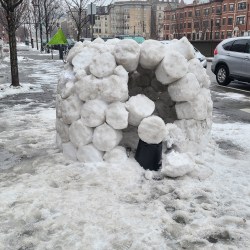
Walking through Boston’s winter streets, I spotted something unexpectedly brilliant—a bucket repurposed to shape blocks of snow for building an igloo. A playful, artistic creation that sparked a sense of delight and curiosity in me—an unexpected moment of joy from something so simple.

It was a reminder: Creativity is about perspective. It’s not about having perfect resources—it’s about asking, What can I create with what I already have? Even in the coldest conditions, there’s opportunity to build and innovate.

This moment inspired me to create this video.

View this post on Instagram

A post shared by Christina (@chohesive)

So, embrace the chill. Design through it. Build in the face of resistance. The warmth you’re searching for often comes from the act of creating itself. 🔥

#Creativity #Innovation #DesignThinking #UXDesign #Leadership #Resilience #InspirationEverywhere #WinterInspiration

Design Perspective: Q&A

I was asked to do a Q &A session to talk about the UX team I started years ago because our team was new and most people didn’t understand what design was and why it was important to the company. I reflected on what I said then compared to how I run my current UX team and realized I haven’t changed too much in my strategy. I decided to share the article because it might be helpful to those who are getting started with staffing up a UX team. (Some edits were made to remove contact/location information).

Q&A wit​h Christina Ho

Human-Centered Design Director
John Hancock

Q: What kind of services does your team provide?

CH: We are comprised of user experience generalists who provide various design capabilities, ranging from discovery through strategic design, service design, usability testing, user research, and data analytics. We also help with creating low to high fidelity prototypes/workflows and visual design. At the core, our team focuses on providing human centered design​ and the application of UX best practices.

Q: What role does your team play in the organization?

CH: We are part of the digital transformation team working in agile XP methodology, so by design, we are embedded as part of the core digital squads. A typical squad is made up of engineers, a product manager, and a product designer – which is our role in a digital squad. In addition, we provide support to other design teams throughout the organization – such as brand, marketing, and the innovation team.

Q: Why is it important to have design embedded into every project?

CH: An embedded design team member on a project helps the team clearly define customer problems and make sure the team is solving the right problem, while adding value to the business. Furthermore, we help establish and champion design methods and processes that support and enable the digital transformation and our culture. As product designers, we serve as an integral part of the team – serving as the voice of the customer. We obsess about our customers – they are the center of all that we do.

Q: You have mentioned that your team helps with Discovery? What do you mean by Discovery?

CH: Discovery is the start of a project. During this stage, we first help a team identify the right stakeholders and key decision-makers. Next, we talk with customers so we can better understand what they truly need, as well as identify their pain points. Why do we do this? By talking to our customers firsthand, we can ensure what we build will be the right solution to address our customers’ needs. Conversations with customers help the team develop empathy and perspectives that open up the range of opportunities to positively impact John Hancock’s customers. We notice new things and gather insights based on our conversations and interactions. We are then armed with a wealth of field data that we bring back to the team to help them define problems they are trying to solve.

Q: When is the good time for a team to reach out to you?

CH: In the beginning. we often find that people view design as only visual and bring us in when the solution is finalized – this leads to many missed opportunities. If you involve a product designer early, we can help identify whether a product designer’s involvement is required. If we find that there is a need, we can help bring real customer problems to light early, helping teams find the right solution that helps resolve them.

Q: Who can request services from your team?

CH: Anyone. Whether you’re a business owner, product manager, or an engineer that needs help with design, or just have questions about design, you can reach out to us anytime. You can find us sitting on the 2nd floor, email us or find us on Slack. We also post frequently on the #topics-design channel.

Q: How do you typically work with your clients. What’s your process?

CH: We typically start by having an initial conversation with our clients to understand what the ask is, and, also have them fill out an intake form. Before we begin doing any work, we want to understand the business problem we are asked to help solve. If the project has high business impact, i.e. direct to customer projects, we are more likely to work on the project, given that we have resources that have bandwidth to take on new projects. We find that using a pairing model – have both a lead designer and embedded designer – to be very effective for the team. We work closely with the product manager/product owner throughout the process. We begin with a kickoff meeting where we try to identify all the key players, discuss how our discovery process works, and at a high-level, set clear expectations of the outcomes to expect from this initial stage, which typically takes about 8 weeks. The lead designer tends to drive these activities – i.e. scheduling of the research plan and deliverables, while the embedded designer will be focused on execution. This usually involves in-person/video/call interviews, constant communication with key stakeholders, and data gathering throughout the process.

Once we have completed the discovery phase, we move into the Design phase where we begin ideation – thinking about all the possible ways to solve the problem. When we get an agreement from the team on which solution to use, we begin to do prototyping (low fidelity, no color designs). We intentionally do this so our stakeholders can focus on the function/workflow and not be hung up on the visuals; it is easier to comment on those. We work in iterative cycles, whether it’s during prototyping or testing phases. Our goal is to test quickly to make sure we are on the right path and not waste precious engineering time. If not, we can pivot and adjust more easily with shorter feedback loops with our customers/stakeholders. Upon the completion of the research, we provide reports containing our findings and recommendations.

On a day-to-day basis, we have daily updates with the team to give each other updates on progress and address roadblocks and produce a weekly/bi-weekly report outlining on-going research activities to the entire team. We constantly analyze and synthesize our findings and make sure that the entire team is on the same page. For our own team, we primarily use Slack for team communication/collaboration. We also offer an opportunity to include people who might be interested in shadowing us during our research activities, so they get to know the customers better.

Q: We know you are tasked in establishing Community of Practice for the Design discipline. Why do you think we need it and who will benefit from it?

CH: Everyone can benefit by being part of our community. As part of the company’s digital transformation, we need to establish processes that will allow design practices to be shared and adopted across the organization. Today – design is solving complex issues to ensure the products we produce are competitive and, most importantly, desirable by our users. We are currently working with different teams from other segments to help bring alignment as the design community and provide support to one another. It’s a very exciting time at for us. We know the importance of using human centered design in our company and we created a website to talk about this in more detail.

​Just to shed light on the current work we have been/and are working on, our customers span from the following business units: Insurance, GWAM (RPS), IT Operations, Brand/Marketing, Annuities, Digital Advice, Risk, and Global. We have other topics available on our site – a research toolkit, section about design systems, lean canvas, customer journey mapping, and many more topics to come.

Q: What kind of projects would you like to be working on?

CH: I like working on projects that involve finding innovative ways to solve real customer problems. That said, I don’t have a preference between working on designing new products and services or updating existing ones. I believe that even with existing products we can find innovative ways to bring improvement. As far as my team is concerned, I encourage them to be more proactive than reactive, and find projects that they are passionate about – that make them excited.

Q: How does one initiate a request to get services?

CH: Easy! Just send us an email and someone from our team will reach out to you to set up an initial consultation.

Euro Trip to Greece Gone Wrong

My adventures in Greece with my brother have left a memorable imprint in my mind in 2008 – a story that is just too colorful not to share. Before we even boarded the plane, there were a few mishaps, starting with me being locked out from both my apartment and car, and the slip of the hand with a razor that left my brother with a streak of buzzed hair. Upon arriving at the airport, my brother realized his luggage was tagged incorrectly with a woman’s name, but it was no surprise to me, since Air France has never had the greatest customer service.

The overall flight to Greece wasn’t too bad, and we also managed to find the hotel without a problem. Just when we thought things were looking up, we realized that someone had stolen one of our cameras, in which precious moments—our dad’s retirement party and certain birthday celebrations—were stored. That put a damper on things, but we decided that there was nothing we could do and went out to have a nice, authentic Greek meal. We picked a local restaurant a few blocks from where we stayed and requested octopus, and the waiter quickly looked at us doubtfully, asking if we really wanted to eat the creature with lots of legs, as he motioned with his flickering fingers. We gave a nod of approval and both thinking the same thing, “We’re Chinese – we eat everything!”

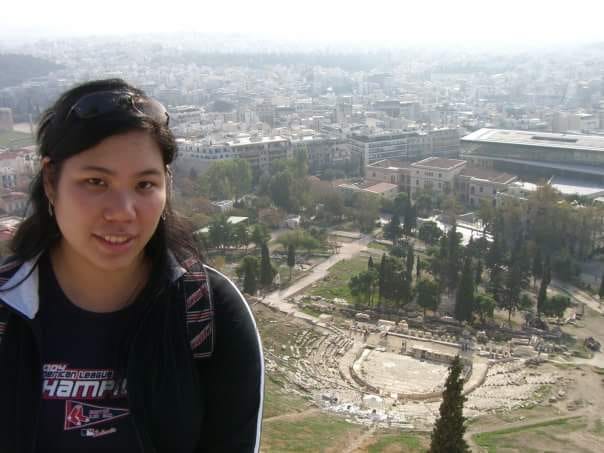
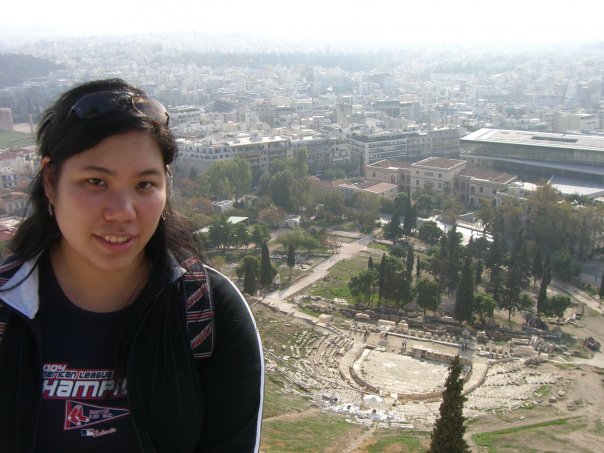
After a somewhat good night’s sleep, we headed downtown to carry out our duty as tourists: we hiked up to the Acropolis, got a bird’s eye view of the city and visited the Parthenon. It was probably one of the few times we were genuinely having fun and smiling in photos in Greece. Everything that happened after we had landed Greek soil was, to say the least, disastrous. As we found our way down towards the remaining must- see sites, which we were furiously trying to cover in a day, my nose started to bleed nonstop, which later became an ongoing problem during the rest of the trip. I had packed every possible medicine you can imagine, but nothing that could resolve my nosebleed. Meanwhile, my brother ran into some bad luck where he trampled on his only pair of sunglasses after a fumble.

As we continued the path hoping to find the underground cemetery, Kerameikos, we spent a lot of time getting lost. Along the way, we found the two Agoras (market places). I dropped my camera trying to take a photo, but thankfully, my camera only suffered a few scratches. What became a common theme for us was being a magnet for trouble.

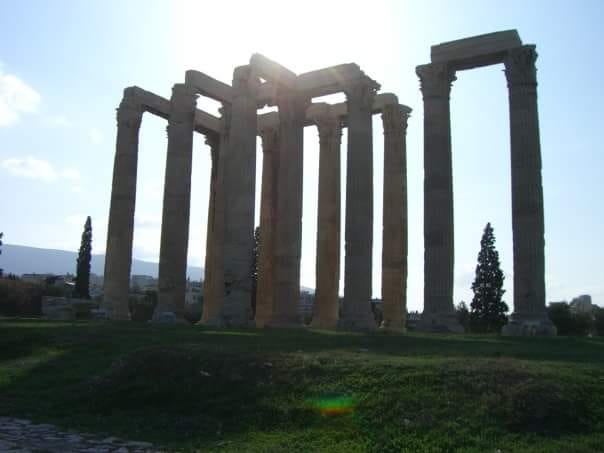
I’m not saying I’m the type to break the law, but Greece is one place you can most definitely do it without trying. One Sunday, as we watched people of all ages run the marathon, we slowly made our way to see the Temple of Zeus (our third and successful attempt), and began taking pictures in front of landmarks. At one such location, after my brother had taken a photo for me, a man with a machine gun jumped from behind the bushes behind a fenced garden, greeted my brother politely, but told us we were breaking the law and would be arrested if we didn’t leave immediately. We left in a flurry and didn’t look back. Monitors constantly warned us as they blew into their whistles and yelled at us for stepping on forbidden grounds or taking photos we weren’t allowed to. There was even one time when my brother accidentally tripped over a rock and landed sitting on part of a wall, for which he got yelled at. In retaliation, I touched the archway wall in defiance for the photo.

We grew tired of the eating Greek food after a few days because everything tasted the same to us, and we tried desperately to find any type of Asian food, but to no avail. Then we found our safe haven for food – McDonalds in Syntagma Square! I’m not one to indulge in fast foods, but it was truly a blessing to have normal food. One thing we found ironic about Greece was that people are known to have longevity due to their diet, but they smoke everywhere and all the time! We also realized there was a large dog population. This is truly sad because many owners abandon their pets on the streets, which leads to an even more distressing problem for us. There is no other way to say it, but the country smells like feces. It’s EVERYWHERE and totally unavoidable. I’m not even going to start talking about the sewage problem, but I’ve learned to appreciate toilet paper – something that seems so trivial. There’s also a cat problem too, but not as prevalent, but one thing I learned was to not play with the cats with semi-closed slanted eyes. Originally I had thought their eyes were different because they had to survive on the mean streets on Athens, but in actuality, we later found out that they were infected with the cat flu! Needless to say, my brother didn’t appreciate me constantly feeding stray cats while we ate lunch.

We had taken several day trips, to and from small mountain cities, such as Delphi, one of few days we almost had no trouble, with the exception of my brother accidentally ripping the strap off a duffle bag when he had offered to help a woman move her luggage, after insisting she didn’t need help. We managed to make it to a few islands, but it seemed like everything was against us at that point. On one of the days we decided to go island hopping using the infamous Flying Dolphin (speed boat), we purchased our tickets and handed it to the woman at the port who informed us that the ports to the two islands were on strike for two days (the two remaining days we were to stay in Greece).

This leads me with the two stories from the trip that has left me scarred. The first was a last-minute decision to go to Corinthos because of the port strikes. Other than Athens, most cities had non-English speaking people, and more importantly, this city was dangerous. As luck would have it, not only did we miss a few buses going to Ancient Corinthos, but also the people were rude to us since we weren’t Greek. They usually flagged us as “stupid Americans,” which was pretty disheartening. We decided to pretend to be from China, since people became more welcoming once they thought we were Chinese tourists; however, on the flip side of things, ironically, fellow Americans harassed us the most. Once the harassment got so bad that we lost our appetite during breakfast and cut our trip short.

Anyway, as we made our way to Corinth, we came to our breaking point. I had prayed hard that things would be better and I said to my brother, “Things can’t get any worse, right?” Then bus driver dropped us off at a stop, and left us stranded on a dirt road. My brother was angry at this point, on the verge of cursing, and I was frantic and almost in tears. Thankfully we found our way to the site, and upon entering, we both started to feel nostalgic, walking where the Apostle Paul defended his apostleship in Corinth.

Finally–the story about the island Agia Marina. According to a guidebook, we would be able to enter this particular town if we took a shortcut. At the time I felt really uncomfortable taking the route, considering the sign consisted of blue marker writings and an arrow, pointing towards a steep, forty-five degree angle, winding pathway. We finally both agreed to take the pathway since it would save at least thirty minutes of walking time. When we were almost towards the end of the road, when three vicious dogs cornered us. At that moment of panic and fear, we were paralyzed and trying to figure out what we should do. I ended up falling twice after one of the dogs lunged at me, leaving bruises on my leg. My brother and I took alternate routes to see if we could escape from them. I scaled over some miniature walls while my brother went through a patch of trees and we managed to find each other on a small roadway. We met a local along the way who kindly walked with us to the small town we had intended to visit. We thought our luck had finally changed, but we ended up being stranded in that ghost town for nearly three hours, and all the stray dogs followed us; we felt somewhat like the dog whisperer. My brother later told me that during his life of knowing me, he had never seen as much fear in my eyes as the time we were harassed by the dogs. Bad luck had haunted us like a ghost since Day One and still showed no sign of leaving–on our last day in Athens, we were robbed once again. At that point, we were already feeling numb and immune to anything bad that happened. I arrived at Logan Airport exclaiming, “I love Boston!” and “Boston Rules!” to which the Customs agent found amusing. My brother vowed never to leave this country again, and for myself, I felt like I needed to have a makeup vacation. We found out later that shortly after our departure from Greece, people were rioting in Athens. I guess we were lucky to leave before it happened.

Although the trip wasn’t what I had expected, I had learned that no matter how much you plan for anything, unexpected things can happen. And when you are in your most vulnerable state of mind, you begin to realize who matters most. As the saying goes, “The past is a history, the future is a mystery, and today is a gift – that’s why it’s called the present.” Be appreciative of those who love you and live your life to the fullest everyday. You never know what’s going to happen next! Happy New Year, Everyone!

(This article was originally published in the SAMPAN newsletter on January 16, 2009.)

Social Intelligence: Why is This Important to Designers?

In the world today, we, as designers, are often reminded that our focus should be on empathy, though there are 4 other dimensions that are equally important. According to Karl Albrecht, social intelligence consists of 5 dimensions: presence, clarity, awareness, authenticity, and empathy. So how do we hone in our skills on the other 4? According to the book, “Executive Presence: The Art of Commanding Respect Like a CEO” by Harrison Monarth, we can develop these skills. I’ve highlighted some key takeaways that I found relevant to design thinking.


Takeaway 1: Use your senses more deliberately by focusing on your five senses. Increasing your awareness allows you to assess the effect of how certain situations have on people, which improves your empathy and presence.

My Experience: I find that putting yourself in other people’s shoes is the best way to connect with your users. Put aside your own experience and expectations and feel what your users feel. 

Takeway 2: Critically assess your strengths and weaknesses. This will help you become more self-aware of yourself, so that you will build confidence and understand your limitations.

My Experience: When complex problems arise and you find yourself stuck, it’s often very helpful to have co-designing sessions with other designers and even engineers for brainstorming sessions.

Takeway 3: Be authentic. When you start having honest conversations about your concerns and issues you care about, people will listen. This is the key towards a more profound interaction.

My Experience: Many times people think that presenting only the good is the best way to connect with people, though when you are faced with real, hard problems, you many need to address the hard questions by being honest about the risks. Having an open discussion will lead to a possibility of solutions when people are fully engaged.

Takeway 4: Be simply in communication. Use simple words and terms to convey a clear message. This will be more effective when engaging with your users.

My Experience: When I facilitate usability sessions, I speak in a slow and clear manner. I want to make sure that the users walk away with a clear understanding of what I’m trying to achieve and what I need from them to make the session successful.

Takeway 5: Practice empathy. Put yourself in someone else’s position by imagining how they perceive things. You will expand your awareness of that person, making future interaction more authentic.

My Experience: When users reply to your questions with very few words, it’s a sign that you are not connecting with them on their level. There are many difference reasons why they might be disengaged, so it’s your responsibility to find out why. Once you break that barrier, you will be surprised how talkative and engaged the users will be.

Takeway 6: Practice empathetic listening. Communication is not just a verbal interaction, but requires listening as well. You may miss vital information or visual cues, and your responses may seem stilted if you lack the focus or don’t pay attention to others.

My Experience: Take the time to observe every aspect of your users. If you can shadow their daily routine, you can better relate with them. Your observations will be far more valuable than any of the research you do online, reading through books, or hearing from your SMEs. It’s always better to learn through your own experience.

How to Get Organized for a New Project (Part 1: Design)

Have you ever struggled organizing your thoughts when starting a new project? You know exactly what you need to do to get to the finish line, though your mind is all over the place – either due to a deadline or because you can’t decide what design application or technology to use. Balsamiq, the Adobe Suite, and Sketch are all applications I use for design and at different stages of a project. So how do you keep track of all these files?


design-apps

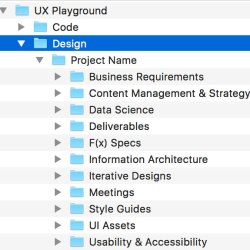
I use a simple approach right from the beginning. I use a folder structure template that serves as a collection of design and code assets.

My “UX Playground” folder contains 2 main subfolders: “Design” and “Code”. I separate these 2 because there is little overlap (with the exception of images/sprites, but even those are generated/compiled differently. More on that in another post). I tweaked my folder structure recently by adding “saas” under the “Code” folder and “Sketch” under the Design/UI Assets folder.

Design

  1. I focus on filling the “Business Requirements” and “Usability & Accessibility” folders first. During this phase, I work closely with business owners and stakeholders to understand what the needs are (i.e. meeting with SMEs and research competitors). From these conversations, I collect data and continue to do research (i.e. create personas, write case studies, and begin sketching ideas). “Content Management & Strategy” can come into play early on if lots of content already exists, though this usually starts later, alongside the iterative design phase. Of course, there will be ongoing administrative tasks that need to be captured and reports that will be analyzed throughout the project; these are categorized under “Meetings” and “Data Science“, respectively.
  2. I take this collection of information and work on the “Information Architecture” and “F(x) Specs”, simultaneously. It’s tempting to put off the functional specs to the very end, though I find it easier if I start early on – capture your thoughts as you design. You are less likely to miss something and risk having developers ask you to explain your thoughts and/or misunderstand the UI. Avoid leaving information out – the last thing you want is to confuse them or have them waste time on development; this will only extend the time to code and delay your target deadline. If a deadline is tight, I will write a lightweight functional spec that gets integrated with a storyboard to lay the ground work of what the vision of the project is heading. Often times, people are more focused on completing deliverables rather than focus on producing a great design experience. By telling the story of the users, it helps remind the stakeholders what we are trying to solve and why we are designing the product. There are many ways to define these types of workflows – the key is to make sure this sets the structure of your design and it stays consistent.
  3. If a product is new, a style guide will need to be created. If a new product is part of a larger suite of applications, then use the existing style guide and existing UI assets. The bulk of the work a designer focuses on is building a library of UI assets (i.e. vector artwork, SVGs, mobile vs. Web visual cues). Usually these designs evolve from the prototyping phase, though setting these up before you jump into a complete UI will serve you better. Create reusable libraries because it will help make your design process faster. Most applications will allow you to build one – I use them frequently in InDesign and recently in Sketch.
  4. Now the fun begins – iterative designs. If you are part of a lean #UX process, you will be prototyping and modifying the product frequently. Because this process tends to go at a rapid pace, it would be wise to keep track of all your work. It’s very common that some of your earlier designs may be desired at some later point in time. I store all the versions under the “Iterative Designs“, and most often than not (depending on your organization), a source control application isn’t used to keep version control of these large design files.
  5. Once you have completed the product designs, I drop them in my “Deliverables” folder, along with any documentation and UI assets that are required to begin coding. I normally name them according to a milestone so I can be reminded of the product’s progress. It’s always fun to see how a product has evolved over time.

Summary: When juggling multiple design projects, take advantage of reusable assets. Invest time to build and/or consolidate your resources. You will benefit in the long run and be prepared for new products in the pipeline. The end goal is to provide precise designs and documentation that detail the intended interactions and behaviours for developers to code. In my next post, I will talk about how I approach organizing my “Code” folder.

Aesthetics vs. Functionality

I am a software engineer by trade and also a designer for as long as I can remember. I thought it would be interesting to see how my peers viewed design, especially with the explosion of the importance of UX in everything we design for clients. Here is a scenario I presented to understand the mindset of designers vs. engineers. Phone #1 has the most immaculate design you have ever seen, but it cannot make phone calls. Phone #2 is fully functional, tailored exactly to your needs, but has a simple box design in black and white; both phones are priced at the same amount. Each person must select one of the phones. Pause for a second and think about which one you would like.

I was surprised at the survey response I received about these 2 hypothetical phones.

  1. Those who chose aesthetics – about 55% of people (all designers) picked this one because they felt possessing such a phone was a privilege and gave them a sense of being part of something special. The visual experience alone was worth it, even though the phone did absolutely nothing a basic phone would allow. I asked one UI designer the reason behind his choice and how he planned to make phone calls. He said he would just buy another phone just to call people and didn’t mind carrying 2 phones in his pocket.
  2. Those who chose functionality – about 30% of the people (mostly engineers, except for one designer) opted for the fully functional phone. They all said that it was an obvious choice because a phone’s primary purpose was to make phone calls. Logically, they would not spend money on something that didn’t work. Most of them said they didn’t care too much for the appearance of the phone because they would buy covers/cases for them anyway. One UX designer explained his reason for choosing functionality over aesthetics was because he liked black and white; otherwise, he would have gone with the other phone.
  3. Those who wanted both – the remaining 15% of people (a mix of both designers and engineers) opted for this alternative and asked why I proposed such an unrealistic scenario. I told them I was curious to see how designers and engineers valued and viewed what was important in a product. I later presented the results from collecting my data and pointed out that the majority of people opted for the non-functional phone, even though I was clear that it would never function like one. The novelty of having a beautifully designed phone was something they wanted to experience and possess.

Summary: When I proposed this question, I thought more people were going to opt in with #3 – challenging me to provide a more balanced option. I realized that what we design and the message that we communicate along with a product is essential. If it’s important enough to the consumer, they will buy anything – especially if there are no other options.

I feel that this is also true when we purpose products as well. There will be many options out there and we do our best to find what suits our needs. I believe that if we find a way to target those 15% of the market, products like phone #1 and #2 would be obsolete and only then would a product be true to design, providing a complete, user experience.

(Photo taken by Taner Ardali).

The Struggle Between Quality vs. Quantity

Have you ever struggled with being asked to produce more just to show progress instead of designing quality work? This happens often and we ignore it when clients are demanding and deadlines are tight. I’d like to share one experience with a project on how I handled the situation to change the mindset of the business owner to realign the project’s original purpose.

  1. Communicate First – try and reason with the business owner the difference between smoke screen progress vs. real progress. I worked on a project that was a mess from the beginning. A VP, the business owner, determined the success of the project based on how many UI screens I designed on a daily basis. He would come by unannounced and hover over my desk, to see how many I produced. We also had a new director on board to manage the project – he only cared about keeping the VP happy so he used those wireframes I designed as a measure to show success. When I explained to him that the project would not be successful with this approach and told him we needed to design it correctly, he did not want to hear anything that would delay meeting deadlines. He then told me to change the background colour to a different one to show a drastic visual change for our upcoming demo. He knew the business owner would be tricked by this simple change. I was disheartened and knew reasoning wasn’t working, so I tried another approach.
  2. Show by Action – deliver what was asked, but also show better alternatives. I walked into a meeting where the senior execs, directors, and team members, were awaiting the first demo. The business owner gave the pitch and was raving about my progress. He then turned to me and asked me if I agreed with him – that what I designed was as amazing as he thought it was. I said I designed what I was told to design. The business owner was confused at my response and demanded that I explain myself. I went on to say that I am not doing the job I was being paid to do. Everyone was shocked at my response. I went on to ask one question: “Are we designing this product to excel in the market or are we just trying to copy our competitors?” That stirred up a lot of uneasiness, and not surprisingly, there was still no response. I went on to show them a few other design options that would improve the product and explained that they were just some ideas to propel us in the right direction. People started to talk. It worked – I got their attention.
  3. Encourage Collaboration – engage stakeholders to be invested so they can help with making the product great. Now that you’ve successfully made your point, the stakeholders will, at the very least, feel that something has to change and will be more open to suggestions. They may even help come up with ideas you did not think of before. Ask for feedback from these stakeholders – this is invaluable information that will help improve the overall design of the product. Expect to receive positive and negative responses – use these to your advantage. Usability is essential in the design process and it will determine if your designs will provide a great user experience.

Summary: Communication is the key to a success product from beginning to end. Never lose sight of the purpose of your product so take action and come up with compelling designs. Accept that the design process takes time, and it will require collaboration and investment from the team to get your product to where it should be. Let your designs be your voice.

(Photo taken by Marian Chinciusan).

Kick-Start Your Dream in Less Than 15 Minutes

I was having a conversation about the success and failures of businesses over dinner with a friend visiting from NY. I pointed out that I noticed successful people become successful by doing what they love. I have been in positions where I would work 90 hours a week to solve a problem that was supposedly unsolvable. I loved the challenge so the hours did not matter to me. It prevented others to pursue such a venture, given the amount of effort and investment with something that may fail. Everyone wanted the problem solved, but no one wanted to do the work, especially when we were all told it’s impossible, so don’t bother. The thought of ultimate failure never occurred to me though. If something didn’t work, I would try something else. I did not fail because I loved what I trying to solve and I refused to give up until I succeeded.

I told her that I am happier at doing what I love than stay stagnant and be complacent with what I have right now. Accepting limitations and agreeing to stay within the boundaries is not fun at all. Her eyes lit up and she opened up to me about her dream – a dream she had be running through her head, but hesitated to take that first step even though she knew it would make her happy. I asked her a series of questions to figure out what was really holding her back.

People naturally find reasons to justify why they would not try something new. I think the reason is because of fear. It’s not necessarily just the fear of failure, but also the fear of success. What if the idea because successful? I will have new problems to solve. How will I handle it? The problem becomes a spiral effect of many what if’s, and your mind makes you think it’s not worth the trouble. And so, you dismiss these ideas, burying them deep into your subconscious.

So how did my friend get her break through? It didn’t happen immediately after dinner – we talked for hours, walked a bit, enjoyed some coffee, and drifted into other topics. We ended up going back to my apartment to continue our Netflix binge, and we drifted back to talking about her dream. I looked at her and said with conviction, “I can help you setup a website for your business – right now. I can show you – it’s easy.” She agreed.

We had the name of her business already and surprisingly no one registered the domain name. This is usually the hard part. I asked her to give me her tagline and it rolled off her tongue effortlessly. I typed it in – done. I proceeded to set up a website using a theme appropriate to her business. It matched her vision. I then asked her to set up accounts for her social media presence. We hit a stag with an email – it was already taken. It’s not a problem – make it unique. She quickly added NYC – done. The last step was the credit card. This post would have been called “Kick-Start Your Dream in Less Than 10 Minutes” if it weren’t for that 5 minutes of hesitation. All the what if’s came roaring in like a storm. I could see the hesitation in her eyes.

“I can change anything I want later, right?” she asked.

“Absolutely. Just do it,” I replied, and it was done.

She said, “I guess it’s decided – I will be running this business in New York!” My friend was happy, excited, and mostly, relieved. Why? All the doubts she had were answered in a short amount of time, and it all came from her. I only asked questions to get her motivated to take action.

I received this text this morning from her: “Thank you for helping me get my dream started yesterday! That was so much fun!”

We often aim for perfection, though we need to start somewhere. Take action to begin the journey towards your dream. You will succeed.

Employee Recognition Award

Back in 2011, I was working at Pega as a UX Designer. On one typical morning, I was designing at my desk, giving my updates during the daily scrum meeting, and replying to emails from our offshore teams. The company meeting was scheduled that day as well, and I was surprised to hear that the CEO had announced that I was the recipient of the Employee Award. He talked for a bit about my contributions to Pega, and concluded by saying how I was both creative and pragmatic. They asked me to fill out a questionnaire so people could get to know me better. Below is the email distributed to the company a few days after the announcement.

Christina Ho, User Experience Designer

Christina Ho joined Pegasystems in June 2010 as a User Experience Designer in Product Management.  Prior to joining Pega, Christina was a Web developer at Dell Services Federal Government at the Volpe Center, Department of Transportation. Christina received her Bachelor of Arts in Computer Science from Boston University.

Christina has been instrumental in a number of key projects this year. Christina has had a hand in enabling and delivering outstanding User Experiences in applications and frameworks ranging from overhauling the Case Management UI (AKA Next Gen Case UI), Collections, Eligibility and Enrollment for Government, Adaptive Conversation Manager (AKA Offer Management) and Marketing Execution Manager.  Not only has Christina often had to juggle doing many of these project simultaneously, but has done it while helping other peers and members of the Pega Family without hesitation.  Christina’s enthusiasm, energy and passion for everything she does is contagious.  Everyone around her is energized by her commitment to deliver above and beyond excellence…she epitomizes being PEGA (Passionate, Engaging, Genuine, and Adaptive) and then some!

Congratulations, Christina!

Here are some fun facts about Christina:

What Is-

…your funniest or fondest memory about Pega?

Recruiting a team for the Fitbit challenge and winning it in half the targeted time. I remember one evening in the NH office my team and I were strategizing on how to maximize the number of steps in the shortest amount of time, without getting injured, while walking around a conference table. That’s dedication and teamwork. Go, Angry Nerds!

…The book you are reading now?

I’m reading two books actually.

  1.      Total Immersion: The Revolutionary Way to Swim Better, Faster, and Easier by Terry Laughlin and John Delves. This is an excellent book to read if you want to learn how to swim correctly and efficiently.
  2.     Hunger Games by Suzanne Collins. This is a story about a fight to the death on live TV, the first book of a three part series.

… Always in your fridge

A variety of fruits and baking soda – which reminds me – I need to replace the baking soda, soon!

Your greatest extravagance

Boring answer: my home. Guilty answer:  my latest splurge on a Louis Vuitton bag I bought in Paris. I still have a hard time justifying that purchase.

… Happiness to you?

A balance of three aspects in my life:

Self – be able to express myself creatively through the arts and music without constraints.

Relationships – be surrounded by loyal, honest, and dependable people who can let loose, laugh, and share the ups and downs of life.

Work – always looking for the next challenge and finding a solution. I don’t like to be bored.

…and maybe one more thing… all topped off with yummy, “real” gelato! :9

…The silliest thing you’ve ever done?

My kindergarten teacher made silhouettes of the class and pinned them up on the wall. I noticed that my nose looked different from everyone else’s, so I went up to the teacher and asked her why. She paused for a moment, and said I was “special”. She made it sound like something was wrong with me so I went home and asked my mom the same question and she offered me a solution.

I spent every night with a clothespin clamped on my nose for fifteen minutes, until one night my mom walked in and asked me what compelled me to do such a painful thing. Hellooo? It was your idea, MOM! She rarely joked with me after that. I still listen and take her advice, but not about my button nose. Happy with it, just the way it is :o)

…Your favorite past time

Right now it’s a tie between sea kayaking in Maine and swimming. Ask me again in 5 years – it may change.

If you-

…Won the lottery today, what would you do tomorrow?

Make plans to pay off my families’ and best friend’s mortgage, then setup a meeting with my dad and a family friend to discuss the smartest way to invest and diversify my winnings.

…Could meet anyone (past or present) who would that be

I’ll pick a past and present since I’m torn between two people.

Past: Since I was 8, I’ve always admired Beethoven’s compositions and enjoyed playing his pieces. He was a fearless, brilliant man with determination even after he became deaf. His music is filled with drama, unpredictability, and a fighting spirit.

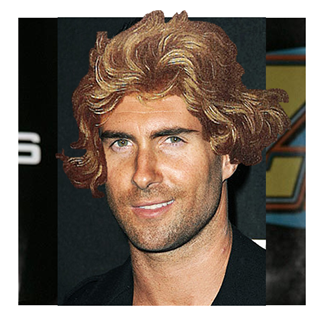
Present: ❤ Adam Levine…!!! Need I say more?

…Come back to earth, what/who would you come back as?

I thought about who I would want to be, but drawing a blank. I’m happy with my life and have no regrets. I’d come back as myself.

I received a thread of responses – I’ll share one Director’s 15-minute Photoshop handiwork he sent back.

Adam-Beethoven