

Aesthetics vs. Functionality

I am a software engineer by trade and also a designer for as long as I can remember. I thought it would be interesting to see how my peers viewed design, especially with the explosion of the importance of UX in everything we design for clients. Here is a scenario I presented to understand the mindset of designers vs. engineers. Phone #1 has the most immaculate design you have ever seen, but it cannot make phone calls. Phone #2 is fully functional, tailored exactly to your needs, but has a simple box design in black and white; both phones are priced at the same amount. Each person must select one of the phones. Pause for a second and think about which one you would like.

I was surprised at the survey response I received about these 2 hypothetical phones.

  1. Those who chose aesthetics – about 55% of people (all designers) picked this one because they felt possessing such a phone was a privilege and gave them a sense of being part of something special. The visual experience alone was worth it, even though the phone did absolutely nothing a basic phone would allow. I asked one UI designer the reason behind his choice and how he planned to make phone calls. He said he would just buy another phone just to call people and didn’t mind carrying 2 phones in his pocket.
  2. Those who chose functionality – about 30% of the people (mostly engineers, except for one designer) opted for the fully functional phone. They all said that it was an obvious choice because a phone’s primary purpose was to make phone calls. Logically, they would not spend money on something that didn’t work. Most of them said they didn’t care too much for the appearance of the phone because they would buy covers/cases for them anyway. One UX designer explained his reason for choosing functionality over aesthetics was because he liked black and white; otherwise, he would have gone with the other phone.
  3. Those who wanted both – the remaining 15% of people (a mix of both designers and engineers) opted for this alternative and asked why I proposed such an unrealistic scenario. I told them I was curious to see how designers and engineers valued and viewed what was important in a product. I later presented the results from collecting my data and pointed out that the majority of people opted for the non-functional phone, even though I was clear that it would never function like one. The novelty of having a beautifully designed phone was something they wanted to experience and possess.

Summary: When I proposed this question, I thought more people were going to opt in with #3 – challenging me to provide a more balanced option. I realized that what we design and the message that we communicate along with a product is essential. If it’s important enough to the consumer, they will buy anything – especially if there are no other options.

I feel that this is also true when we purpose products as well. There will be many options out there and we do our best to find what suits our needs. I believe that if we find a way to target those 15% of the market, products like phone #1 and #2 would be obsolete and only then would a product be true to design, providing a complete, user experience.

(Photo taken by Taner Ardali).
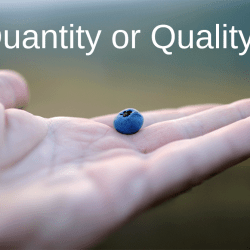
The Struggle Between Quality vs. Quantity

Have you ever struggled with being asked to produce more just to show progress instead of designing quality work? This happens often and we ignore it when clients are demanding and deadlines are tight. I’d like to share one experience with a project on how I handled the situation to change the mindset of the business owner to realign the project’s original purpose.

  1. Communicate First – try and reason with the business owner the difference between smoke screen progress vs. real progress. I worked on a project that was a mess from the beginning. A VP, the business owner, determined the success of the project based on how many UI screens I designed on a daily basis. He would come by unannounced and hover over my desk, to see how many I produced. We also had a new director on board to manage the project – he only cared about keeping the VP happy so he used those wireframes I designed as a measure to show success. When I explained to him that the project would not be successful with this approach and told him we needed to design it correctly, he did not want to hear anything that would delay meeting deadlines. He then told me to change the background colour to a different one to show a drastic visual change for our upcoming demo. He knew the business owner would be tricked by this simple change. I was disheartened and knew reasoning wasn’t working, so I tried another approach.
  2. Show by Action – deliver what was asked, but also show better alternatives. I walked into a meeting where the senior execs, directors, and team members, were awaiting the first demo. The business owner gave the pitch and was raving about my progress. He then turned to me and asked me if I agreed with him – that what I designed was as amazing as he thought it was. I said I designed what I was told to design. The business owner was confused at my response and demanded that I explain myself. I went on to say that I am not doing the job I was being paid to do. Everyone was shocked at my response. I went on to ask one question: “Are we designing this product to excel in the market or are we just trying to copy our competitors?” That stirred up a lot of uneasiness, and not surprisingly, there was still no response. I went on to show them a few other design options that would improve the product and explained that they were just some ideas to propel us in the right direction. People started to talk. It worked – I got their attention.
  3. Encourage Collaboration – engage stakeholders to be invested so they can help with making the product great. Now that you’ve successfully made your point, the stakeholders will, at the very least, feel that something has to change and will be more open to suggestions. They may even help come up with ideas you did not think of before. Ask for feedback from these stakeholders – this is invaluable information that will help improve the overall design of the product. Expect to receive positive and negative responses – use these to your advantage. Usability is essential in the design process and it will determine if your designs will provide a great user experience.

Summary: Communication is the key to a success product from beginning to end. Never lose sight of the purpose of your product so take action and come up with compelling designs. Accept that the design process takes time, and it will require collaboration and investment from the team to get your product to where it should be. Let your designs be your voice.

(Photo taken by Marian Chinciusan).